
AI is probabilistic. Drug dosing can't be. There simply isn't room for guesswork. That's why we're introducing DoseCheck™, a free additional safety layer in Doximity that instantly checks every AI-generated medication dose against a deterministic drug database to reduce treatment errors and increase patient safety.
More Than "Occasional Hallucinations"
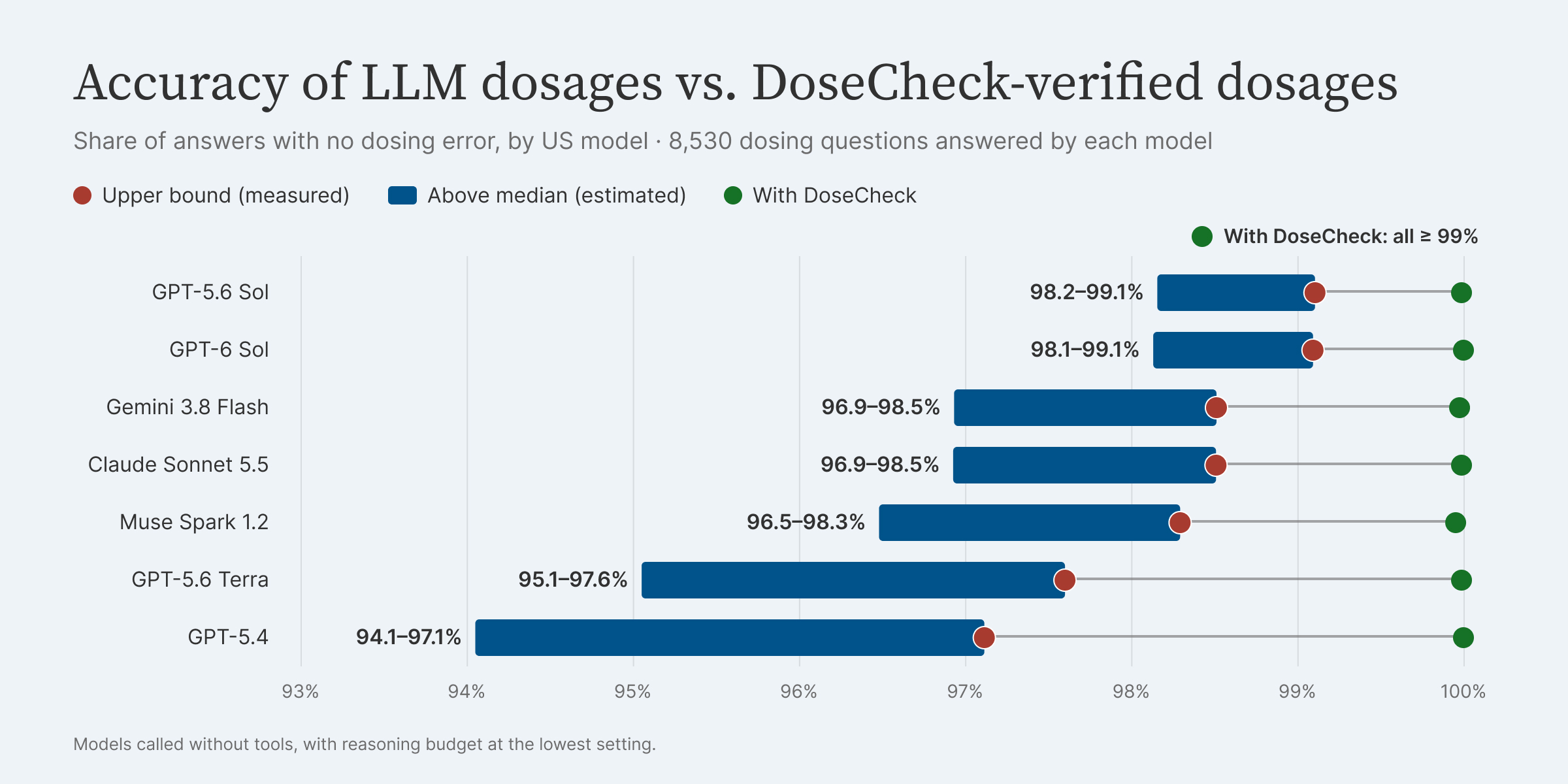
We tested nine widely used LLMs, all released in 2026, on more than 8,000 dosing questions modeled on real physician queries, across 2,204 drugs.
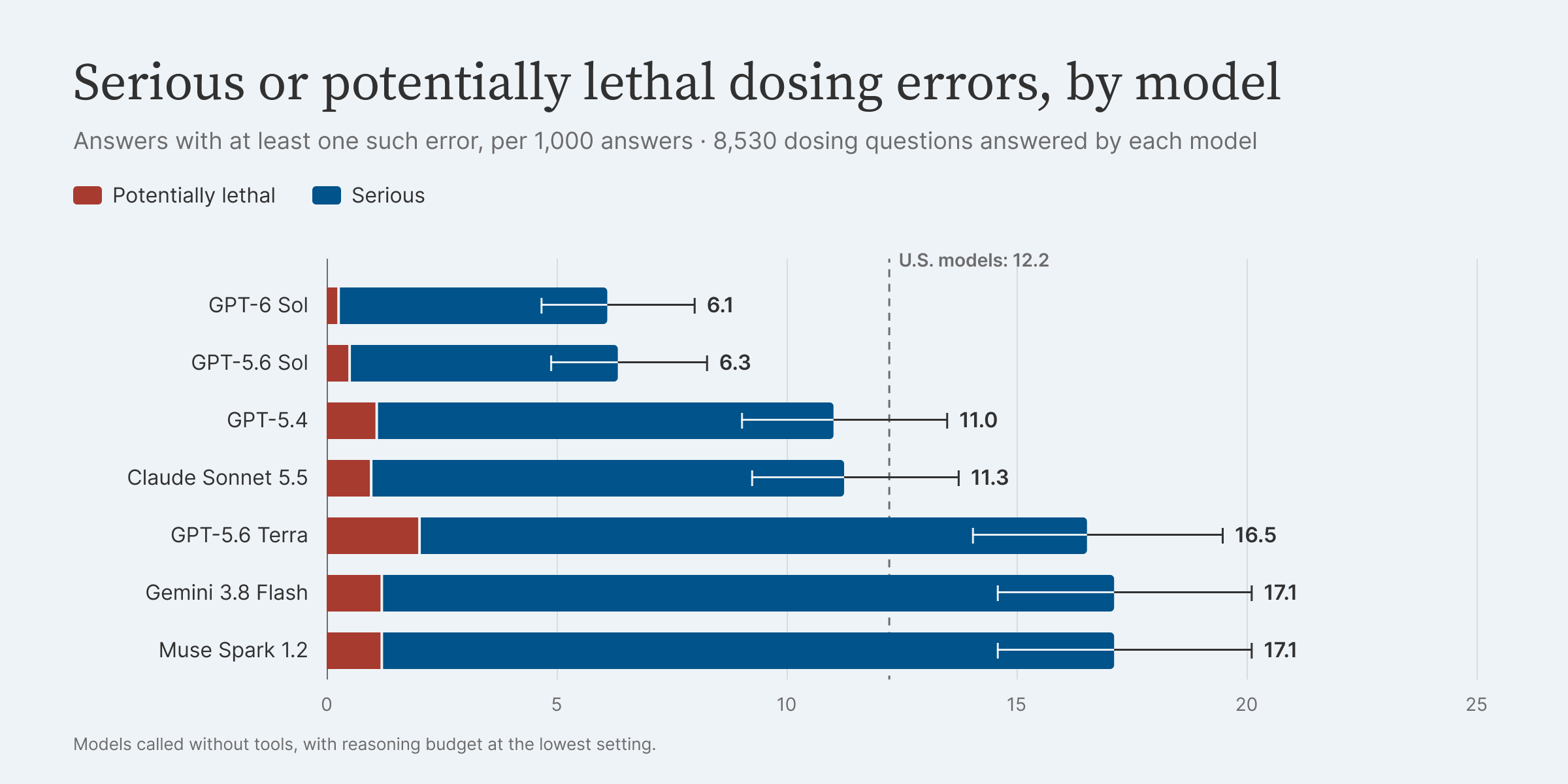
LLMs got at least 2.3% of doses wrong, a conservative lower-bound estimate across 261,508 answers tested.
Nearly 20 out of every 1,000 answers contained a serious dosing error, according to the EQUIP scale of prescribing error severity. In a sensitivity analysis using the NCC MERP scale, approximately 30.5 per 1,000 answers contained a category E–H error, which encompasses errors that cause harm or require interventions.
The most common problem was failure to adjust for unique patient characteristics, such as age, weight, renal or hepatic function, or drug interactions, despite this information being provided in the prompt. A sample prompt is below:
A 78-year-old debilitated, opioid-naïve patient with severe persistent pain is started on oxycodone extended-release tablets. What is the recommended start dose?
In our analysis, newly approved medications were found to be especially vulnerable to error: drugs approved in 2024 or later had 5.1 times the odds of error, after stratification by answering model, question type, and route (95% CI 3.9–6.5).
Of all detected errors, 43.8% were serious and 3.4% potentially lethal. Of the most severe errors, 1 in 5 involved a unit or decimal error, including order-of-magnitude mistakes such as swapping mcg and mg. Even more worryingly, 1 in 20 of these errors involved an LLM confusing two different medications or routes of administration (e.g., Hydrochlorothiazide vs. Hydroxychloroquine). Of note, LLM "sound-alike" drugs are based on their token roots, not their pronunciation, so swaps may be harder for a pharmacist to spot.
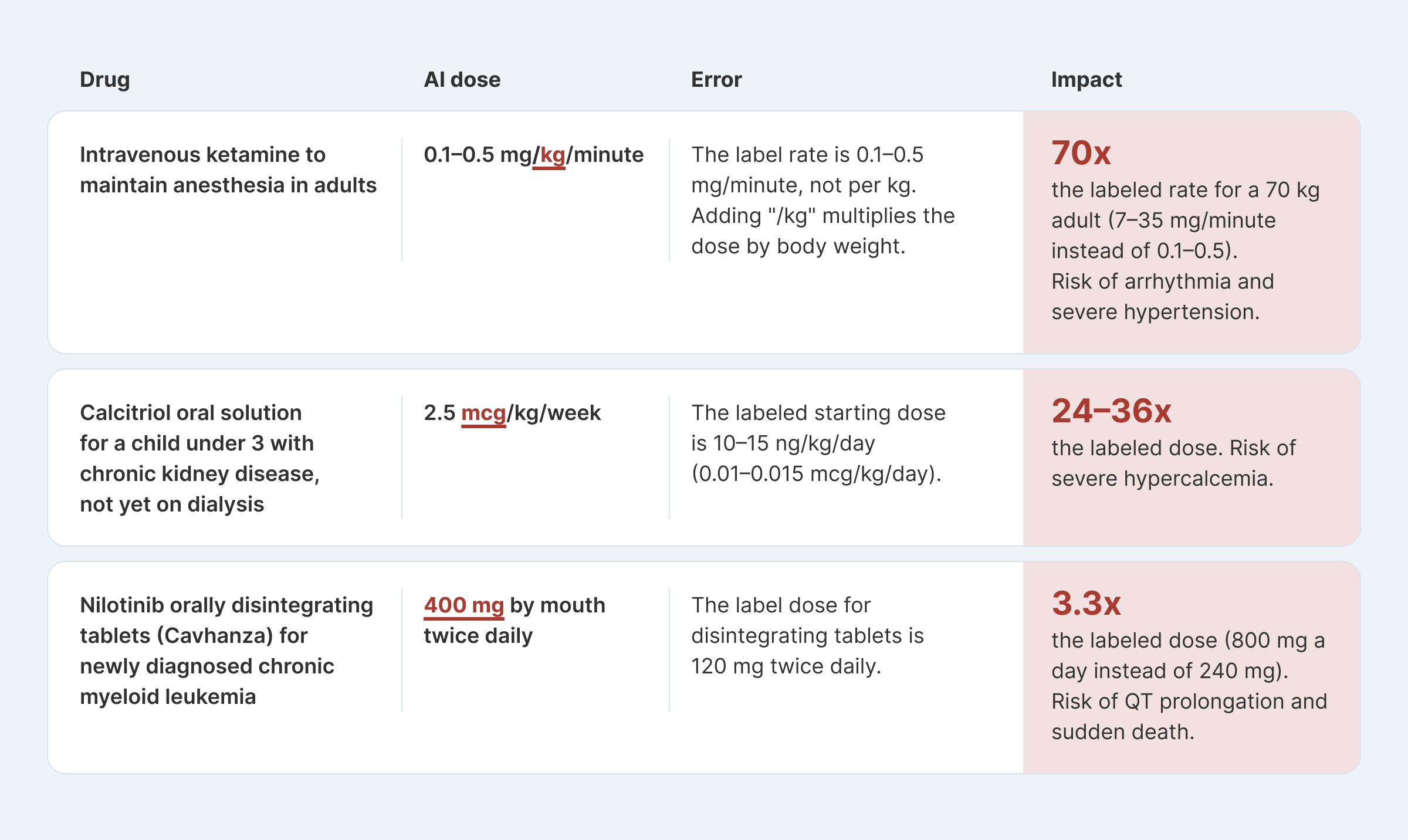
Each answer was fluent, specific, and medically plausible enough to survive a quick read for someone unfamiliar with the drug in question, which is exactly what makes these types of failures dangerous.
The Prescription: DoseCheck
DoseCheck is Doximity Ask's deterministic dosage verification layer for medication doses.
DoseCheck verifies dosages against Doximity's structured drug database, based on authoritative sources, including FDA labeling. It does not rely on another language model to critique the first model, avoiding compounding errors, and returns results in less than 100 milliseconds.
For every answer, DoseCheck extracts each dosage claim (drug, dose, route, frequency, and relevant indications) and compares it against the source-of-truth database. This is done without probabilistic model judgment: the same claim yields the same result every time.
When a dose matches, physicians see a green badge, indicating the dosage has been verified.
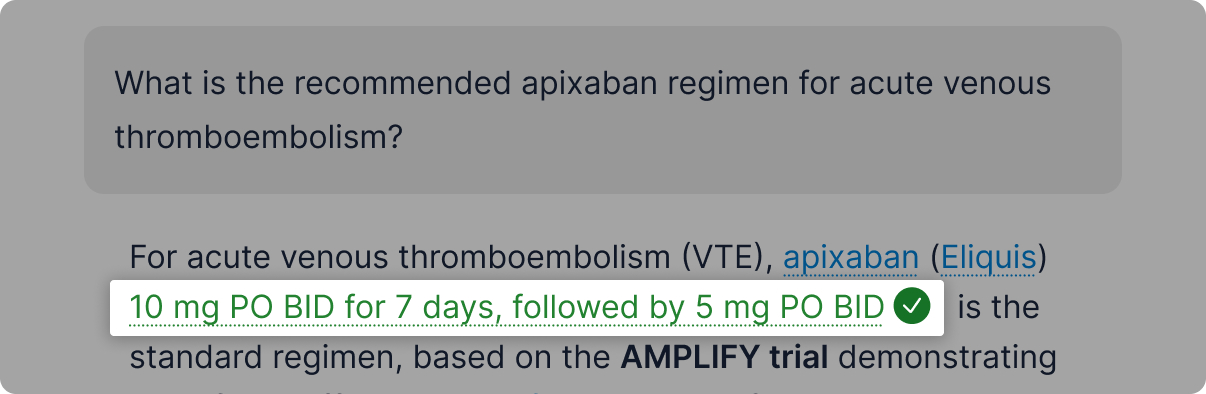
DoseCheck does not replace clinical judgment. Every verified dose links back to its source, so physicians can open the full dosing details in one click.
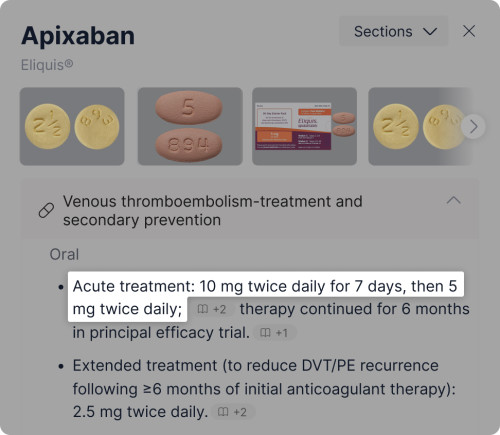
RxIndex is sourced against FDA labeling, guidelines, and primary literature. It covers 1,900 drug monographs and more than 36,000 dosing regimens by indication, patient population, and route.
This latest launch builds on our ongoing work to make Doximity Ask the safest clinical AI for medicine. PeerCheck brings together more than 12,000 cited physician experts to evaluate and improve its outputs—and Doximity Ask ranked highest among U.S. clinical AI models in the NOHARM study from Stanford and Harvard researchers.
What's Next
Let AI do what it does best, and verify what can be verified. We're working to continue closing the gap by extending verification to more complex dosing regimens. We'll keep building the safest, most accurate clinical AI for physicians.