When I began practicing medicine, knowledge was something we sought intentionally and deliberately, through journals, grand rounds, and conferences. After nearly 40 years of practice, from running a rural health clinic in Alabama to serving as the 18th U.S. Surgeon General, I’ve seen how clinicians and patients have been increasingly flooded with medical information. While this rapid rise of available data holds promise, it has also bred confusion and mistrust. Medicine must remain grounded in accuracy and integrity, supported by valid information that enables better patient care.
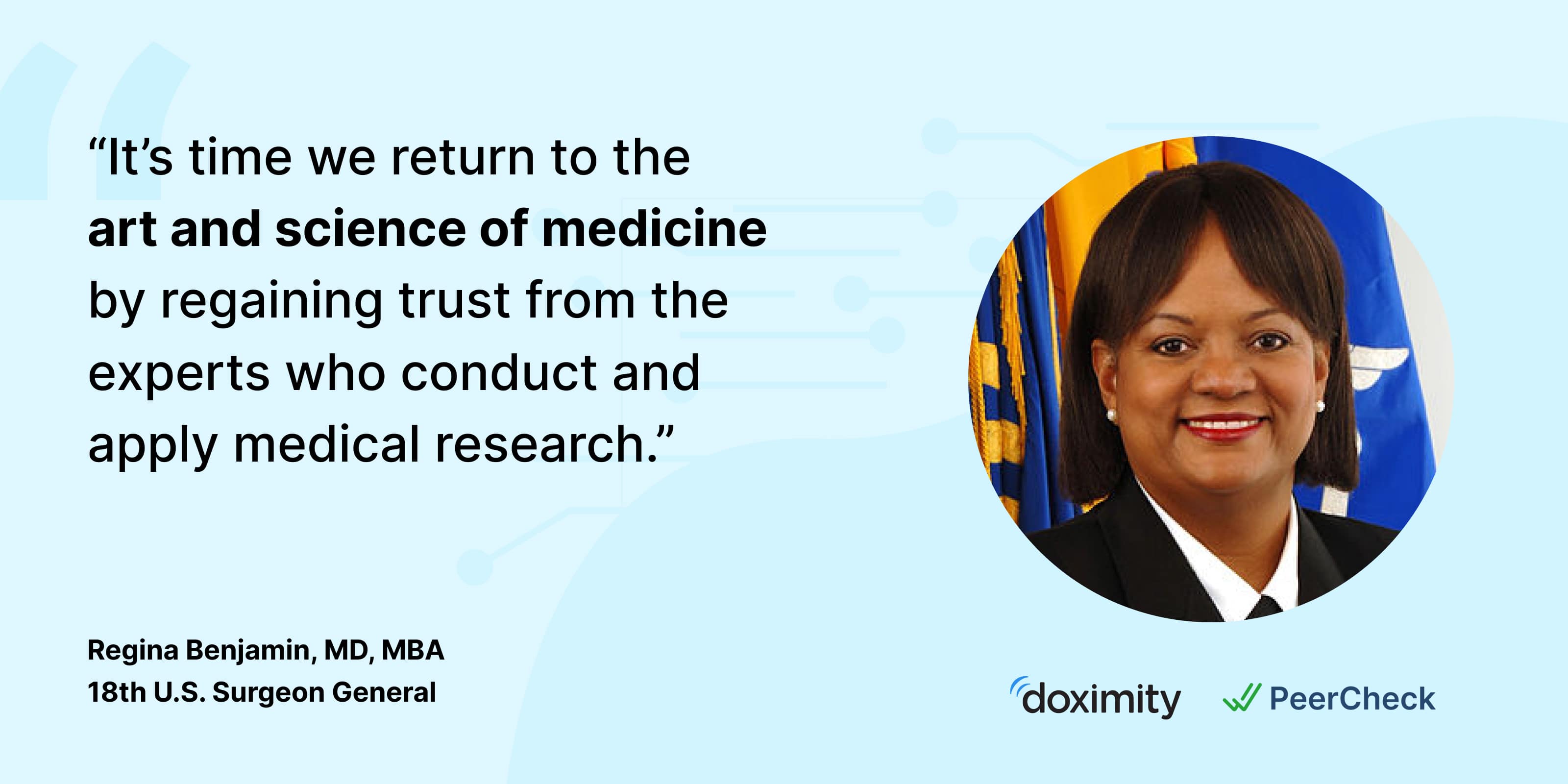
It’s time we return to the art and science of medicine by regaining trust from the experts who conduct and apply medical research. The physicians and scientists who understand not only what the data says, but also how it was generated, interpreted, and how it should be applied in clinical practice.
This is why I’m proud to share that Dr. Eric Topol and I are serving as co–Editors in Chief of PeerCheck™, a new initiative embedding expert peer review directly into Doximity Ask, Doximity’s evidence-based clinical decision support tool. PeerCheck™ brings physicians back into the center of medical knowledge, ensuring information reflects evidence, experience, and real-world judgment.
Just as physicians have always relied on one another for clinical advice and judgement, PeerCheck™ enhances our profession by turning that instinct into a tailored, trusted framework. This added layer of expert review helps ensure Doximity Ask remains grounded in accuracy to support our clinical decision-making.
Join me in helping build an editorial board to ensure the accuracy of medical information. We’re seeking physicians to help review content and guide this framework. If you’re interested in participating, please let us know below.
- Regina Benjamin, MD, MBA